Butoh Performance
"Désir
d'infini"
Desir for infinity (Bach poetry)


presented by Dance Company NUBA
Butoh Solo+ Violin
Running time 20-25 minutesChoreography, dance : Juju Alishina
Violin : Lucien Alfonso
Costumes : Myriam Gravalon
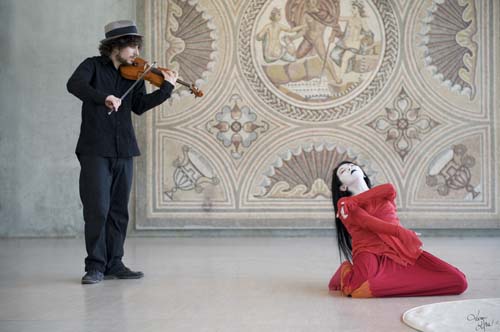
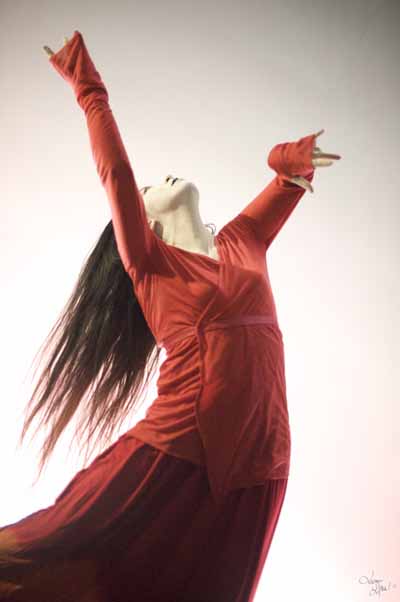
" Désir d’infini " is the most requested Butoh Performance among the 40 pieces of Juju Alishina . she worked on the contrast between ephemeral and eternity to arrive at a form of abstract expression , highlighted by a music of Bach . Juju Alishina plays often in the museums. The company NUBA presented their creations in the Rodin museum, the Guimet Museum, Grand Palais, the Albert Kahn Museum , Gallo- Roman Museum of Saint-Romain-en-Gal , Royal Monastery of Brou, the Textile Museum, Museum of Natural History in Paris, and Striped House Museum of Art in Tokyo.
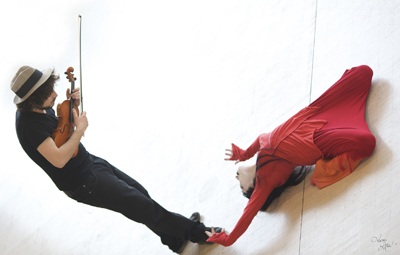
photo : Jean-Claude Flaccomio
Coming soon !
Saturday 16th April 2016at 18:30
Château-musée du Cayla
81140 Andillac France.
Free Entrance
Friday
6th May 2016 at 20:00
Lansdown Hall and Gallery
Lansdown, Stroud GL5 1BB (UK)
£8 - £12
Réservation
Video : Gallo-Roman Museum of Saint-Romain-en-Gal 2010
With this creation, Juju Alishina
tends to a form of more abstract expression, underlined by Bach's music.
Her intent is an approach of the quest for eternity, by underlining different
aspects of life such as how one's life can be lived or the reasons why
our stay on earth is so short?
In terms of technicality, Juju Alishina is with this creation even more
in search of movements in dance, working on contrasts between transitory
state and eternity.
DESIR D'INFINI
On the stage, one can see an unidentified form of life. It slowly moves, like a creature from the depth of the sea, like a giant ray – or like a UFO in the sky.
Little by little, the characters show up, in ghostly, alien forms. Senses awake inside the creature which is becoming alive, a body coming out of another body.
And then, one hears violin: a sonata from Bach.
The birth of the creature: Dance begins. At times soft and subtle, or jerky, but constantly in interaction with the musician with whom the female dancer starts a game of seduction by being alternately affectionate or distant.
Obsessed by her "Desire for infinity", she dances wildly in order to ward off her destiny. Suddenly, like a mechanical doll, she is seized by convulsions.
Her freedom gives way to a madness which expresses itself in her irregular and undefined movements.
Finally, she manages to find serenity.
She returns inside the creature.
"Desire for Infinity" is a quest that manifests itself, either in relation with the music, either in relation with the shape: the "ray" represents an imprisonment as much as a shed.
Such a progression, guided by Bach's sonata, shows how music can seduce the body and vice-versa. There is a very strong interaction between both forms of expression.
The combination between western music and Japanese aesthetics offers spectators untypical baroque pictures.
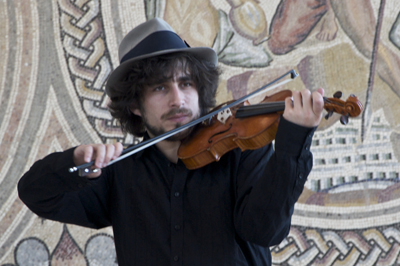
Lucien Alfonso – Violinist
Born in the South of France, Lucien Alfonso enters the National Conservatoire of Toulouse where he studies violin in the classes of Guennadi Hoffmann and Clara Cernat, heirs of the Russian technique of David Oistrakh and Tibor Varga. In 2004, he obtains his diploma in musical studies, and integrates the Improvement Cycle. At the same time as his classical studies, he practises improvisation at the early age of fifteen and is soon found on stage accompanying renowned artists such as Wynton Marsalis, Ben Harper, Nigel Kennedy, Mathieu Chédid or Angelo Debarre. Having a particular appeal for free expression forms, he now devotes himself to the new music, world music and improvised music.
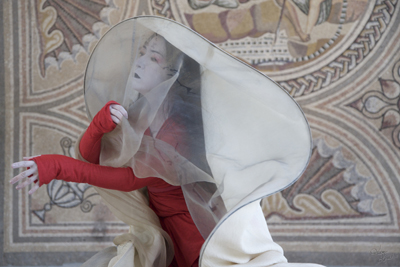
Juju Alishina – Choreographer, Butoh Dancer
Trained in traditional Japanese dance and Butoh, Juju Alishina founded his own company NUBA in Tokyo. In 1998, she moved to Paris, where he developed his own teaching of traditional and contemporary dance. The choreography Juju Alishina, built around the character of Asian dance, today appeales to other disciplines. Juju Alishina is regarded worldwide as one of the leading figures amongst active Butoh dancers. Her method of dance, "Butoh Dance Training – Secrets of Japanese Dance through the Alishina method" was published in Japan in 2010,and is now translated and published in France, Canada, Australia, the UK ans the USA.
PRESS
REVIEW
July 2010 France / web-magazine asiexpo
DESIRE FOR INFINITY (choreography by Juju Alishina)
“Such is Dance, like a blooming flower that
etiolates, it constantly revives and eternally lives." Masakatsu
Gunji
As part of the exhibition “Desires of Eternity : Rituals for the
world beyond” (presented until November 14th at the Gallo-Roman
Museum of Saint-Romain-En-Gal), Choreographer and Butoh dancer Juju Alishina
has been invited by the Musée des Confluences to hold a solo performance.
Accompanied by Violinist Lucien Alfonso, Juju Alishina had been asked
to create an original show for this particular occasion.
What can be told about Juju Alishina, who belongs to the third generation
of Butoh? Fugitive visions at first: just as it is the case for music,
dance is an ephemeral art. This has not escaped Juju Alishina. Does this
mean that the combat held by the body against time is la lost cause? Movements,
gestures may vanish as rapidly as sounds, “something” however,
remains: Dance leaves a print, awakens a form of desire. In echo to the
“Desire for Eternity” questioned by the exhibition, Juju Alishina
chose to name her creation “Desire for Infinity”. This desire
is indeed a desire for dance, which not only redesigns the body, but also
transforms the space.
Yoko Tawada: “Each line that her hands and feet drew in the air
became either beam or column. She builds circumvented houses, spiral rooms,
stairs without steps and floating bridges. A fragile and invisible serie
of rooms.” (Opium for Ovid, Verdier, 2002). In the Gallo-roman exhibition
setting of the museum, Juju Alishina has created these ghostly architectures,
she has opened unexpected doors and passages where would disappear both
imagination... and desire. Moreover, in response to the multiple representations
of death, Juju Alishina shows less concern about the dissolution of one's
identity, one's disappearance or metamorphosis (although the latter may
be found in the show), than in asserting a life force. An impulse insufflated
by Lucien Alfonso in a brilliant and very personal performing of Bach
sonatas.
Therefore, it comes as no surprise that unlike many Butoh shows, Desire
for Infinity may somewhat be characterized by a profusion of many ascending
movements. Juju Alishina invites us to a form of cycle, to a course where
the body passes through many different states before finally reconciling
with the surrounding world.
Original text written by Yann Leblanc
Places where"Désir d’infini"was played
24th, 25th April 2010 at the musée gallo-romain de Saint-Romain-en-Gal (France)
24th July 2010 at the Monastère de Brou, à Bourg-en-Bresse (France)
29th April 2011 at the Espace Culturel Bertin Poirée in Paris (France)
14th September 2014 at the Galerie 59 in Paris (France)
3rd October 2014 Quinzena de Dança de Almada- International Dance Festival (Portugal)
16th April 2016 Château-musée du Cayla (Andillac, France)
6th May 2016 at the Lansdown Hall and Gallery Stroud (UK)
La Compagnie NUBA is supported by National Choregraphy Center.
Technical specifications
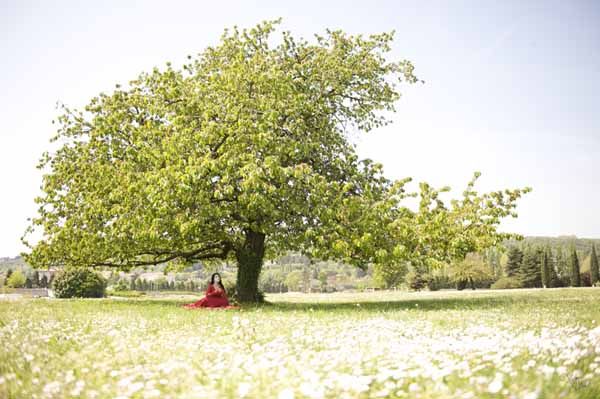
"Désir d’infini" Open-Aiir version
Crew :
We need English or French-speaking staff members for lighting and sound
Dressing Room :
With a big mirror and a lavatory
Non-public bathroom facilities (in or near the dressing room)
Running time of the performance : 20 minutes
Necessary preparation time : 3-4 hours including dancer rehearsal
Stage :
Width: 10 m - Depth: 8 m (minimum / Width: 5 m - Depth: 5 m)
Sound :
1 microphone for wide areas
Lights : Daylight


contact :E-mail
modified: 2016/03/19
©
2001-2016 All rights reserved by Cie NUBA